
Orleans Parish Court Records After Arrest
Orleans Parish court records after a jail arrest usually start with a local arrest, transfer to the Orleans Parish Sheriff's Office, and booking at the Orleans Justice Center. The jail record is not the same thing as the court case. OPSO may list a statute, description, bond type, bond amount, case number, and disposition in the public charge table, but that table reflects jail booking data and later updates from related systems.
The formal case turns on screening and filing. The Orleans Parish District Attorney Screening Division says it reviews felony criminal complaints submitted by NOPD and other arresting agencies, works with investigators, victims, witnesses, and police officers, and decides whether charges are warranted. For the custody side, the jail inmate records page explains the OPSO roster fields. Booking photos and photo limits are handled separately on the jail roster mugshots page.
Find Orleans Parish Court Records
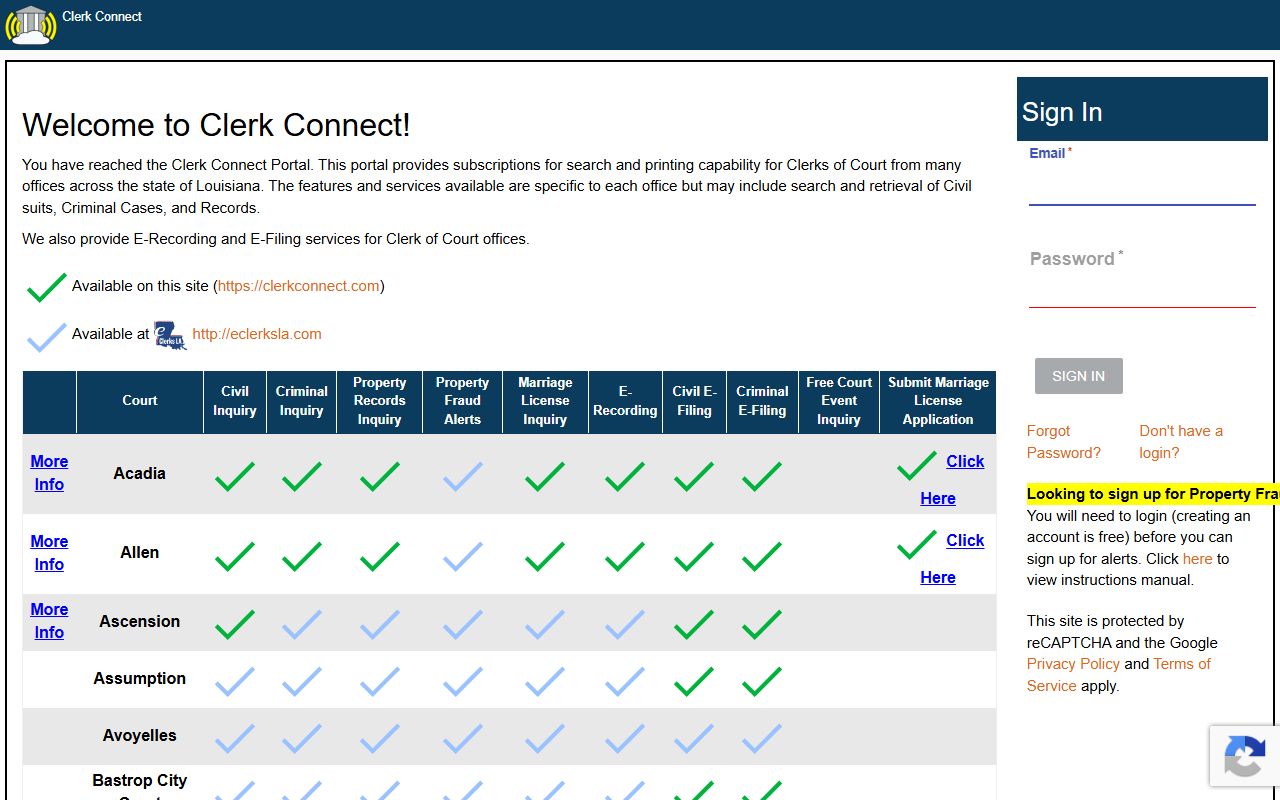
The City of New Orleans criminal justice resources identify Clerk Connect as the free application for Orleans Parish criminal case information, managed by the Clerk of Court. The same City material says Docket Master is transitioning to Clerk Connect. Older local references may still use the Docket Master name, but a current Orleans Parish court records after arrest lookup should start with Clerk Connect and then move to the specific court or clerk office when the portal does not answer the question.
The Orleans Parish Criminal District Court Clerk site is the local clerk contact point for Criminal District Court records, and the clerk phone listed in the research is 504-658-9173. The Orleans Criminal District Court site is the court site for felony criminal matters. Municipal and Traffic Court handles lower-level municipal and traffic matters at 727 S Broad St., New Orleans, LA 70119, with clerk hours Monday through Friday, 8 AM to 4 PM, and phone 504-658-8500.
The successful screenshot below comes from Clerk Connect, the portal the City points to for Orleans criminal case lookup.
Use jail case numbers, defendant names, and court notices together. A case number copied from the OPSO charge table can make Clerk Connect searches more precise when common names return too many results.
| Search Source | Fields or Clues | Use |
|---|---|---|
| Clerk Connect | Office and case-search workflow; exact public fields were not fully captured | Free Orleans criminal case lookup cited by the City |
| OPSO detail page | Case No in the jail charge table | Copy the case number into court searches when available |
| Municipal and Traffic Court | Search My Case and clerk contact channel | Check municipal, traffic, and lower-level court matters separately |
Charges After Orleans Parish Arrest
After an Orleans Parish arrest, booking creates a jail record, but the formal court record is built through a charging decision. A complaint may describe the accusation at the first stage. An information is a prosecutor-filed charging document. An indictment is returned by a grand jury. The exact path depends on the court, charge type, and prosecutor action.
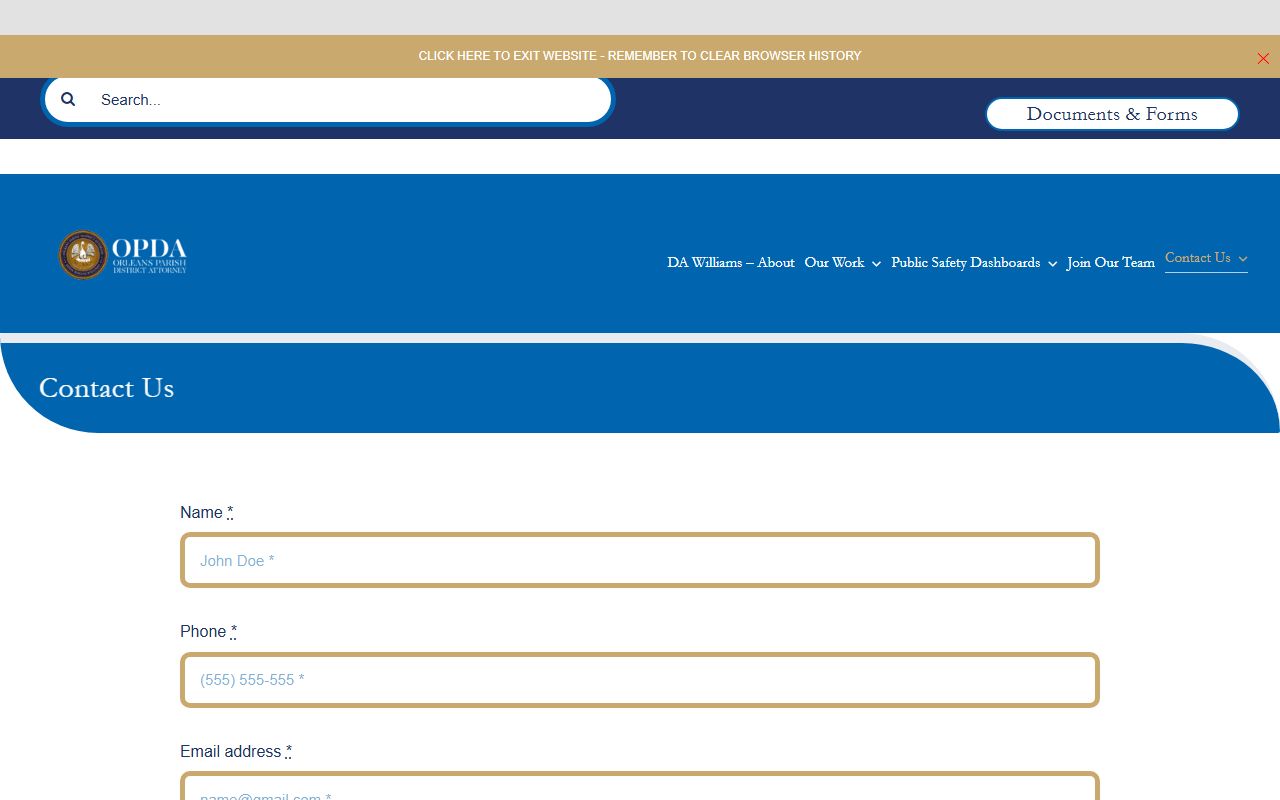
The Orleans Parish District Attorney is Jason R. Williams. The DA main office is listed at 619 South White St., New Orleans, LA 70119. The DA contact page also lists fax numbers 504-827-6396 and 504-827-6365 and provides an online contact form. That office is separate from OPSO and the clerk. OPSO keeps jail custody records. The DA screens and files criminal charges. The clerk maintains the court case file and docket entries.
The DA contact image below comes from the Orleans Parish District Attorney contact page and documents the official office channel used for prosecutor information after an Orleans Parish jail arrest.
For felony screening questions, start with the DA's published contact channels, but rely on the clerk record for filed case entries and hearing dates.
| Complaint | Information | Indictment | |
|---|---|---|---|
| Filed By | Officer or prosecutor, depending on stage | Prosecutor | Grand jury |
| Common Use | Initial accusation or lower-level start | Many prosecutor-filed cases | Serious felony matters |
| Record Value | Shows the first stated charge | Shows the formal filed charge | Shows grand-jury charge authorization |
Orleans Parish Charge Status
Charge status matters because jail booking language can differ from the case that appears in court records after a jail arrest. A person may be booked on one listed offense, screened by the DA, then charged differently in Criminal District Court or Municipal and Traffic Court. A charge can also be amended, reduced, dismissed, or declined as the case moves. A booking is not a conviction.
| Status | What It Means |
|---|---|
| Pending | The charge has not reached final disposition. Hearings, motions, or plea talks may still be open. |
| Amended | The filed charge was formally changed. The new charge should be read from the current court entry. |
| Reduced | The charge was changed to a lesser offense or lower grade. |
| Dismissed | The court or prosecutor ended that charge. Other counts or warrants may still exist. |
| Nolle Prosequi | The prosecutor declined to proceed on the charge. It is often shortened to nolle pros. |
| Conviction | Guilt was found or admitted by plea. Sentencing and custody status should be checked separately. |
Bond After Orleans Parish Arrest
Orleans Parish bond information may appear in two places. The OPSO detail page has charge-level Bond Type and Bond Amount fields. Court records can show bond settings, changes, release conditions, no-bond orders, and later revocations. The local flow is arrest, booking, first appearance or magistrate review, bond or release condition, posting through the correct court or jail process, and release only after every hold is cleared.
City criminal justice resources describe the Public Safety Assessment used in New Orleans pretrial decisions. It produces risk scores for new criminal activity and failure to appear and flags elevated violent-crime risk. The City also states the judge keeps the release or detention decision. No current OPSO public page with complete bond-payment methods, bond-window hours, or a full fee schedule was located in the research, so bond instructions should be confirmed with OPSO, OJC, the clerk, or the court before money is sent.
| Release Term | Plain Meaning |
|---|---|
| Cash bond | Money posted through the required process to secure release. |
| Surety bond | A licensed bail agent posts a bond under a private contract. |
| PR or own recognizance | Release based on a promise to appear and comply with conditions. |
| No-bond hold | Release is not available through ordinary bond payment for that hold. |
| Detainer | Another agency has a hold or request that can delay release. |
Warrants in Orleans Parish Records
No official OPSO active-warrant list was located in the reviewed sources. That means the jail roster is a post-booking clue, not a complete active-warrant search. If a person has already been arrested on a warrant, OPSO Inmate Inquiry may show a charge, case number, hold-related entry, or disposition in the jail record. If the warrant has not led to booking, it may not appear there at all.
Use Clerk Connect for criminal case entries, hearing dates, and bench-warrant clues. Check Municipal and Traffic Court separately for municipal or traffic cases because those matters do not always move through the same court path as felony Criminal District Court cases. Phone or in-person contact with the relevant clerk or OPSO is still the fallback for warrant questions. Do not rely on third-party warrant pages when a missed court date, bond condition, or old case may be involved.
- Arrest warrant
- A court order authorizing custody.
- Bench warrant
- A warrant often issued after missing court or violating a court order.
- Search warrant
- A warrant authorizing a search, not necessarily custody.
- Fugitive warrant
- A hold tied to another jurisdiction.
Criminal Court Clerk Records
The Criminal District Court Clerk is the practical office for filed felony court records after an Orleans Parish jail arrest. Clerk records may show charges, case numbers, docket entries, hearing settings, motions, pleas, verdicts, and sentencing entries. Municipal and Traffic Court should be checked when the arrest involves municipal, traffic, or lower-level matters rather than a felony Criminal District Court prosecution.
The image below is from the Orleans Parish Criminal District Court Clerk site and supports the clerk-contact path used when a portal search is not enough.

When the jail table shows a case number, keep it with the booking number, defendant name, and date of birth. Those details help separate people with similar names in Orleans Parish court records after arrest.
Charges vs Convictions
A charge is an accusation. A conviction is the result of a guilty plea, verdict, or other final finding of guilt. Orleans Parish court records after a jail arrest may show both, but the terms must not be treated as equal. A person can be booked and charged, then have the charge declined, dismissed, amended, or reduced. A release date in the jail record also does not prove the case ended.
| Charge | Conviction | |
|---|---|---|
| Stage | Accusation after arrest or filing | Final guilt finding or admitted plea |
| Proof Level | Lower early-stage standard, such as probable cause | Beyond reasonable doubt or valid plea |
| Record Effect | May remain public unless restricted or expunged | Can affect sentence, custody, and later eligibility |
| Where to Check | Jail charge table and clerk docket | Clerk disposition and sentencing entries |
Sealed and Expunged Records
Louisiana public-records law broadly includes writings, photographs, electronic records, databases, and other materials used in public business unless an exception applies. At the same time, criminal records can become restricted through juvenile confidentiality, sealed entries, statutory exceptions, or expungement. Louisiana Code of Criminal Procedure articles 971 through 995 govern expungement processes that affect public visibility of arrest and case records.
Expungement does not make every agency forget every event in the same way. The public may lose access while some justice agencies retain limited access for specific uses. Booking photographs have a separate rule in Louisiana Code of Criminal Procedure Article 234, and court-case restriction should be checked through the court record itself.
| Sealed | Expunged | |
|---|---|---|
| Public Visibility | Hidden or limited by court order or law | Removed from normal public access under expungement rules |
| Agency Access | May remain available to authorized users | May remain available in limited statutory situations |
| Typical Trigger | Confidential case type, court order, or legal limit | Eligible dismissal, acquittal, or other qualifying result |
Public Access Limits
For Orleans Parish court records after arrest, the safest access path is to use the office that owns the record. OPSO controls jail booking records. The Clerk controls filed court records. The DA controls prosecutor files and screening information that may not all be public. Municipal and Traffic Court controls its own lower-court records. Records tied to juveniles, sealed matters, active investigations, or restricted booking photographs may not be released through a simple public lookup.
Important: Public lookup text is not a consumer report and cannot be used for credit, employment, tenant screening, insurance, or any FCRA-covered purpose.